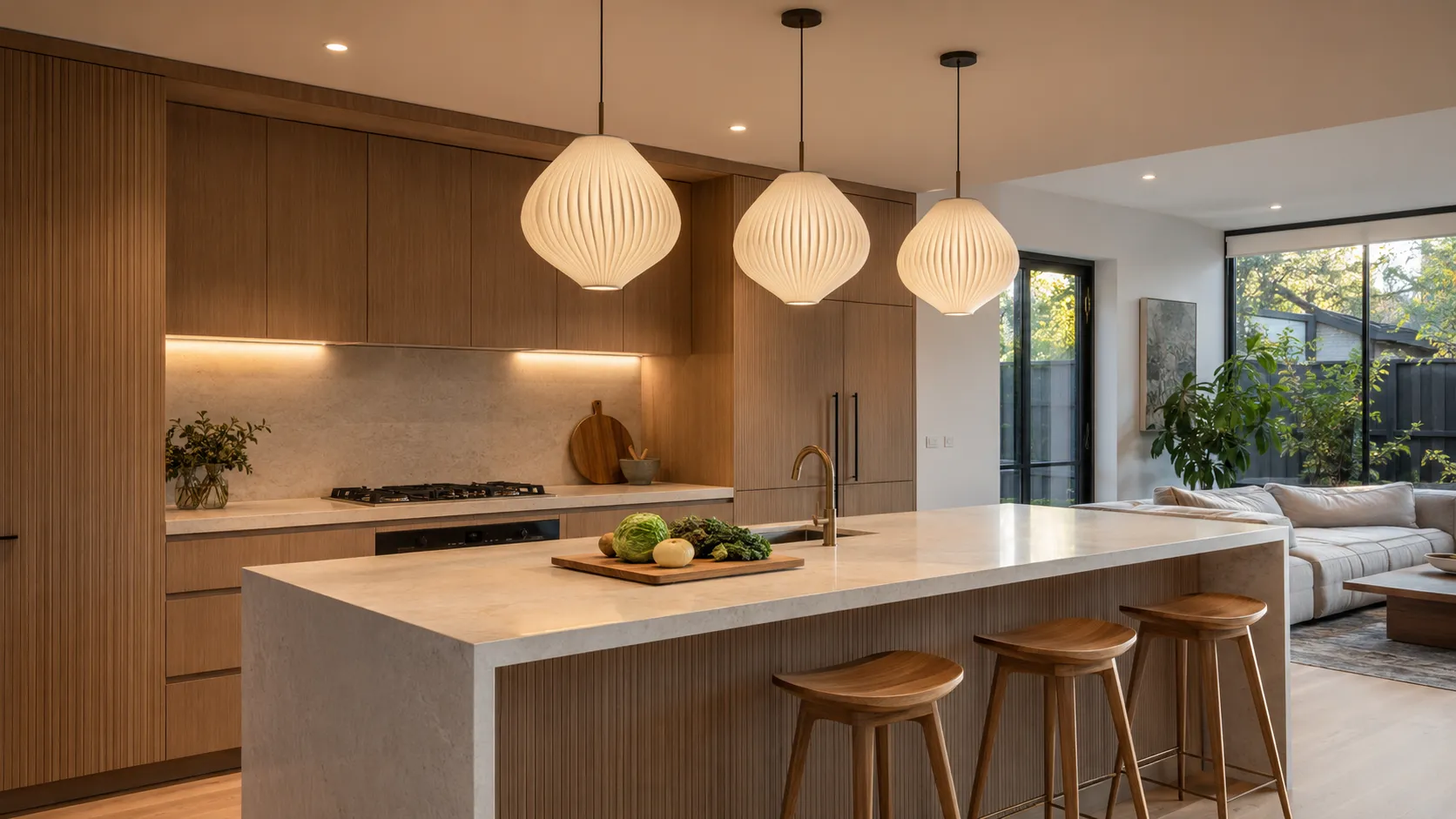
A Melbourne homeowner walks into a nearly finished kitchen. The cabinetry, benchtop and island look perfect, but the ceiling has only one poorly positioned lighting point.
Adding three pendant lights now requires new wiring, plaster repairs and another visit from the electrician. What looked like a simple design choice has become an expensive change.
Pendant lighting remains popular in Melbourne kitchen design because it combines practical light with visual impact. However, successful pendant lighting requires more than choosing an attractive fitting. Homeowners must consider proportion, placement, brightness, cleaning and installation before work begins.
Why Melbourne Kitchens Are Embracing Pendant Lighting
Modern kitchens now support cooking, dining, entertaining, homework and working from home. Pendant lights help define the island as the centre of these activities.
They also introduce warmth and personality into kitchens dominated by neutral cabinetry and stone benchtops. Glass, brass, ceramic and matte black fittings can connect lighting with handles, tapware and other finishes.
Current designs are moving beyond three identical pendants. Melbourne homeowners are also choosing linear lights, two larger pendants and sculptural clusters. These options can create a stronger focal point with less ceiling clutter.
However, popularity does not make pendants essential for every kitchen.
Not Every Kitchen Island Needs Pendant Lights
Pendant lights can overwhelm small kitchens, apartments and rooms with low ceilings. Large shades may interrupt views and make an open-plan space feel crowded.
A standard 2.4-metre ceiling can still accommodate pendants, but the size and hanging height need careful planning. A deep shade or exposed bulb may sit directly within someone’s sightline.
Homeowners who prefer minimal design or easy maintenance may find downlights, track lighting or under-cabinet LEDs more practical. These alternatives can also provide better coverage when the island serves mainly as a food-preparation area.
Before choosing pendants, ask what problem they need to solve. Decoration, task lighting and ambience require different fittings.
Should You Choose One, Two or Three Pendants?
The island should determine the number of pendants, not an automatic design rule.
One well-scaled pendant can suit an island shorter than 1.2 metres. Two pendants often work over islands between 1.2 and 1.8 metres. Three smaller fittings or one linear pendant may suit a longer island.
The shade diameter also matters. As a starting point, the pendant diameter can equal roughly 20 to 35 percent of the island’s width. A 900-millimetre-wide island may suit shades around 200 to 300 millimetres wide.
Spacing should account for the shade size and light spread. The fittings need enough separation to avoid looking crowded while still illuminating the island evenly.
Homeowners should suspend cardboard templates before installation. This simple test reveals whether the proposed lights feel balanced from the kitchen, dining area and living room.
How High Should Kitchen Pendants Hang?
Most professional guidance places the bottom of a kitchen pendant approximately 760 to 910 millimetres above the benchtop. Treat this as a starting range rather than a fixed rule.
The correct height depends on the ceiling, shade, exposed bulb and household members’ heights. The island’s function also matters.
A pendant hung too low can block views and create glare. One hung too high may look disconnected from the island and provide weak focused light.
Check the proposed height while standing and sitting around the island. You should also view it from adjoining rooms. If the shade exposes the bulb, raising the fitting slightly may reduce uncomfortable glare.
Finalise the height before the electrician cuts new ceiling openings.
A Beautiful Pendant Can Still Leave the Island Dark
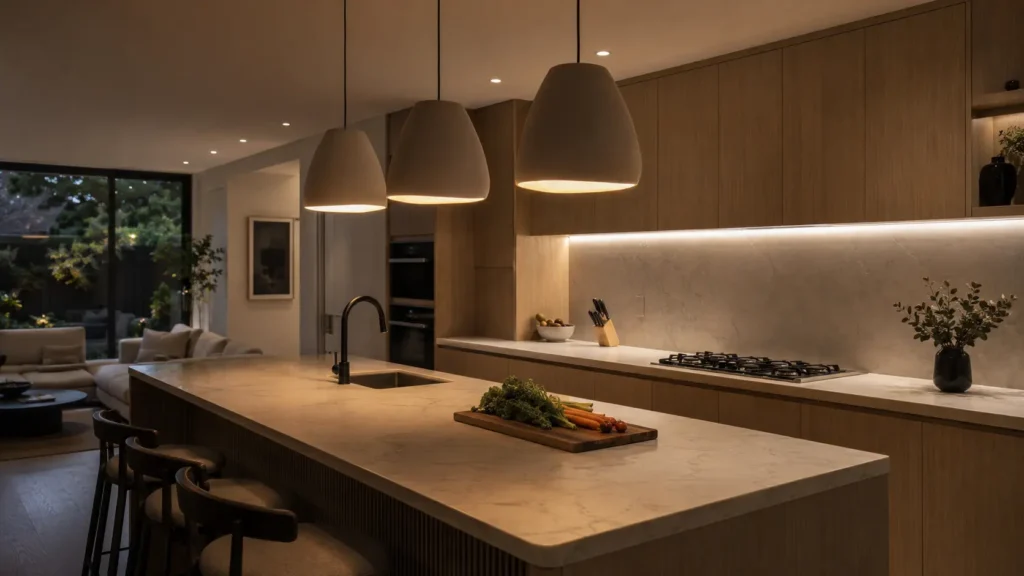
A pendant describes how a light hangs. It does not guarantee useful task lighting.
An opaque shade may illuminate only a small section of the benchtop. Clear glass can spread more light, but an exposed globe may shine directly into people’s eyes. Poor placement can also cast shadows across food-preparation areas.
Effective kitchen lighting uses several layers. Pendants provide decorative or focused light, downlights support general visibility, and under-cabinet LEDs illuminate worktops.
Warm light around 3000K creates a relaxed atmosphere. Neutral light closer to 4000K provides clearer task lighting. Many open-plan homes benefit from one consistent colour temperature and separate dimmers.
Homeowners should check brightness, beam direction and dimmer compatibility before purchasing the fitting.
Installation Costs and Victorian Safety Requirements
Straightforward pendant installation in Melbourne may cost approximately AUD 150 to AUD 350 per fitting. Complex work can cost more, and the pendant itself usually costs extra.
Prices increase when electricians need to add wiring, move connection points or reinforce the ceiling. Double-brick homes, apartments, heritage properties and high ceilings can also create access problems. Plastering and repainting may add further expenses.
Homeowners should request an itemised quote covering wiring, switches, dimmers, ceiling support, repairs, GST and the Certificate of Electrical Safety.
Victoria requires a licensed electrician to complete electrical installation work. The electrician must test the work and provide a Certificate of Electrical Safety. Apartment owners should also check owners corporation requirements before changing shared ceilings or services.
Choose Practical Pendants That Will Last
Kitchen pendants collect dust and airborne grease. Smooth glass, metal and glazed ceramic shades are usually easier to clean than fabric, open cages or woven materials.
Check whether the shade comes apart safely and whether the fitting uses a replaceable globe. An integrated LED may require professional repair or complete replacement when its driver or lighting module fails.
The best kitchen pendant is not simply the latest design. It should suit the island, provide useful light and remain easy to maintain.
Plan the position before electrical rough-in, test the scale with a template and coordinate the builder, cabinetmaker and electrician. Early decisions can protect both the renovation budget and the finished kitchen.
Frequently Asked Questions
How high should pendant lights hang above a kitchen island?
As a starting point, hang the bottom of the pendant approximately 760 to 910 millimetres above the benchtop. Adjust the height for the ceiling, shade size, exposed bulb, household members and sightlines into adjoining rooms.
How much does pendant-light installation cost in Melbourne?
Straightforward installation may cost approximately AUD 150 to AUD 350 per fitting in Melbourne. New wiring, dimmers, ceiling reinforcement, difficult access and plaster repairs can increase the final price, so request an itemised quote.
Do I need a licensed electrician to install pendant lights in Victoria?
Yes. A licensed electrician must complete and test electrical installation work in Victoria. They must also provide a Certificate of Electrical Safety, which confirms accountability for the completed work.